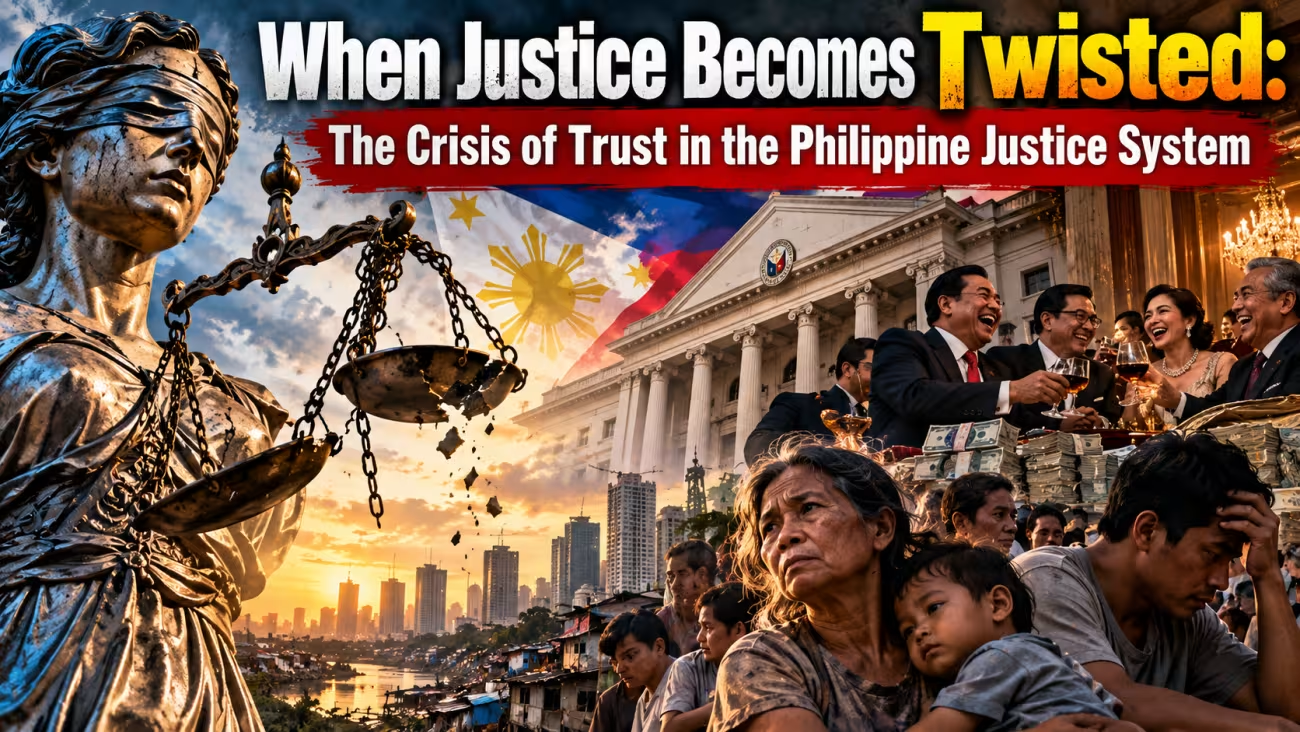
When the rules of justice appear to change in the middle of a proceeding, the damage is not limited to one case. It can affect public confidence in the entire system.
The Philippine justice system is built on laws, constitutional safeguards, courts, and institutions intended to protect due process and accountability. Yet whenever legal rules are interpreted differently depending on the circumstances, ordinary Filipinos can understandably begin asking a difficult question:
Is justice being applied equally to everyone?
Recent events surrounding the impeachment trial of Vice President Sara Duterte have intensified this debate.
A Disputed Impeachment Threshold
On September 23, 2026, the Senate sitting as an impeachment court voted to revise its interpretation of the number of votes required to convict. Earlier, the presiding officer had ruled that 16 votes were necessary, based on two-thirds of the 24-member Senate.
The impeachment court later adopted a different approach: senators who were legally or factually incapable of participating would not be included in the calculation. ABS-CBN News reported that the court voted 13-1 to adopt the revised formula, with several senator-judges not participating in the vote.
The constitutional provision at the center of the dispute states that an impeached official cannot be convicted without the concurrence of two-thirds of all members of the Senate.
The disagreement therefore is not simply about arithmetic. It is about what the phrase “all the Members of the Senate” means when some members cannot participate.
Two Different Legal Interpretations
The prosecution argued that senators who are legally unable to participate should not determine the voting denominator. Prosecutor Chel Diokno described the possibility of retaining a fixed 16-vote threshold despite senators being incapable of acting as judges as potentially resulting in what he called “acquittal by default.”
The defense took the opposite position.
Defense lawyer Michael Poa argued that the Constitution requires two-thirds of all Senate members and that absence, detention, or non-participation does not itself create a vacancy. He also argued that the defense had relied on the original 16-vote ruling throughout the proceedings.
Both positions raise important constitutional questions.
And that is precisely why public trust becomes so important.
When People Begin to Feel Betrayed
For ordinary citizens, complicated constitutional arguments can sometimes feel distant from everyday life.
But the underlying principle is simple:
People expect the rules of justice to be clear, stable, and applied consistently.
When an important legal interpretation changes during a major proceeding, some people may see it as a necessary correction based on circumstances. Others may see it as an unfair change to the rules after the process has already begun.
ABS-CBN reported that the defense described the original 16-vote requirement as a constitutional safeguard and argued that changing the denominator could affect the fairness of the trial. Meanwhile, the prosecution argued that the two-thirds requirement itself had not changed; only the constitutionally applicable membership being counted had changed.
These competing interpretations illustrate why institutional trust can become fragile.
Justice Must Be More Than an Outcome
A justice system cannot depend only on whether people agree with the final decision.
The public also needs confidence in how the decision was reached.
A decision can be legally defensible while still generating controversy. Likewise, a controversial decision does not automatically prove that the system has been corrupted.
The important questions are:
- Was the Constitution properly interpreted?
- Were both sides given meaningful due process?
- Were the rules applied consistently?
- Was the decision supported by legal reasoning?
- Can the decision withstand independent judicial review?
- Can citizens understand why the rule was changed?
These questions matter because justice is not only about punishment or acquittal. Justice is also about procedure, transparency, and equal treatment under the law.
The Door to Judicial Review
The September 23 proceedings also opened the possibility of further legal challenges.
ABS-CBN reported that the defense indicated it may pursue legal remedies, including bringing the constitutional issue before the Supreme Court. The presiding officer also placed the court's procedural reasoning on record in anticipation of possible judicial review.
That is an important feature of constitutional government.
When there is a serious disagreement over the meaning of the Constitution, the legal system contains mechanisms for challenging and reviewing decisions. Such review allows constitutional questions to be examined beyond the immediate political conflict.
A Nation Losing Faith in Its Institutions
The deeper danger is not simply one impeachment case.
The deeper danger is loss of public confidence.
When citizens repeatedly see powerful institutions arguing over rules, procedures, accountability, and constitutional interpretation, some may begin to believe that justice operates differently depending on who is involved.
That perception can be damaging even when the participants sincerely believe they are acting within the law.
A democracy depends not only on written laws but also on public confidence that those laws are being administered fairly.
Betrayal, Justice, and the Voice of the People
This is where the idea behind “Bigo ang Ating Bansa” becomes powerful.
The song does not need to declare that every institution is evil. Instead, it can express the frustration of citizens who feel that the promises of justice, accountability, and good governance have repeatedly fallen short.
The phrase “Tayo'y ipinagkanulo” becomes a metaphor for that feeling of betrayal.
Not necessarily betrayal by one individual.
Not necessarily betrayal by one political party.
But the feeling that the system citizens depend upon has failed to provide the fairness and accountability they expect.
And when people lose faith in institutions, they begin asking harder questions:
Who protects the ordinary citizen?
Who protects the Constitution?
Who protects justice from political pressure?
And who holds the powerful accountable?
Justice Must Survive Political Conflict
Political institutions will always contain disagreement.
Courts will interpret laws differently. Legislators will debate constitutional provisions. Prosecutors and defense lawyers will argue opposing positions.
That is normal in a democracy.
What matters is whether the institutions remain committed to constitutional limits, due process, transparency, and independent review.
The real test of a justice system is not whether it produces the result one side wants.
The real test is whether citizens can look at the process and believe:
The same law applies to everyone.
The Country Can Still Rise
A nation is not defined only by the failures of its institutions.
It is also defined by the willingness of its people to demand accountability, understand their rights, defend constitutional principles, and participate peacefully in democratic processes.
The Philippines has faced political conflict, institutional controversies, and crises of public trust before.
The answer does not have to be despair.
It can be vigilance.
It can be truth.
It can be accountability.
It can be the courage to ask difficult questions without abandoning the principles of justice.
A country may stumble.
A country may become divided.
A country may lose the trust of its people.
But the people can still rise.
Sources
- ABS-CBN News — Impeachment court ends debate on threshold, opens door for judicial review
- ABS-CBN News — Transcript of prosecution and defense arguments on the conviction threshold
- Philippine News Agency — Senate court drops fixed 16-vote threshold in VP trial
- Philippine News Agency — Procedural basis for possible Supreme Court challenge
Comments